



IAT and CAAM Jointly Release Industry’s First White Paper on AI Agent-Powered Automotive R&D
Source: Author: Date:2026-08-13 Read:387
The 2026 China Auto Forum, opened in Jiading, Shanghai, on July 22, 2026, under the theme of “New Start, New Opportunities, New Journey – Jointly Drawing a New Blueprint for High-Quality Development of the Automotive Industry”.
At the forum, the “White Paper on AI Agent-Enabled Automotive R&D and Design – From Tool Assistance to AI-Native Development (2026)” was officially released, co-compiled by the China Association of Automobile Manufacturers (CAAM) and IAT Automobile Technology Co., Ltd., with participation from automakers including FAW, Changan, BAIC, Chery, GWM, Li Auto and NIO.
It is the first industry white paper in China’s automotive R&D sector focused on AI agent-empowered R&D and design, and systematically lays out a complete pathway for automotive R&D to evolve from tool-assisted to AI-native models.
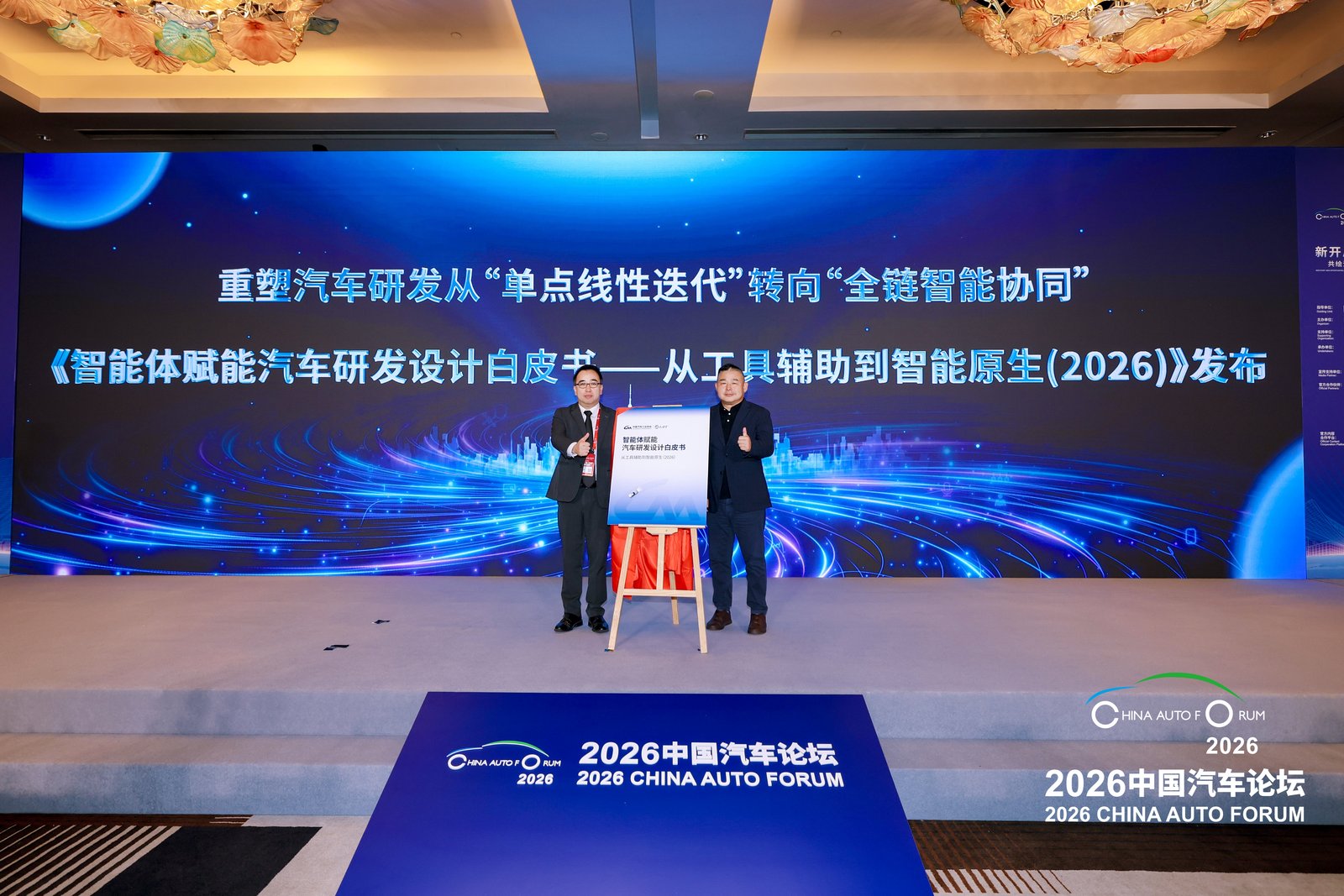
Photo (from left to right): Li Shaohua, Deputy Secretary-General of CAAM, and Xuan Qiwu, Chairman of IAT Automobile Technology Co., Ltd., unveil the white paper.
Currently, competition in China’s automotive market is shifting from “horsepower rivalry” to “computing power contest”, and from “feature stacking” to “system-level capability competition”. The R&D cycle typically ranges from 36 to 48 months for traditional fuel vehicles, 18–24 months for leading industry players, and even approaching 12 months for certain enterprises.
At the same time, the complexity of vehicle systems has risen exponentially: the number of sensors, controllers and actuators has multiplied, and software-hardware interfaces have grown geometrically. Therefore, the traditional R&D model, which relies on human expertise and serial verification, is nearing its efficiency ceiling, and industry competition has escalated into a systemic contest of R&D systems, data assets and AI empowerment capabilities. This is the core driver behind the compilation of the white paper.
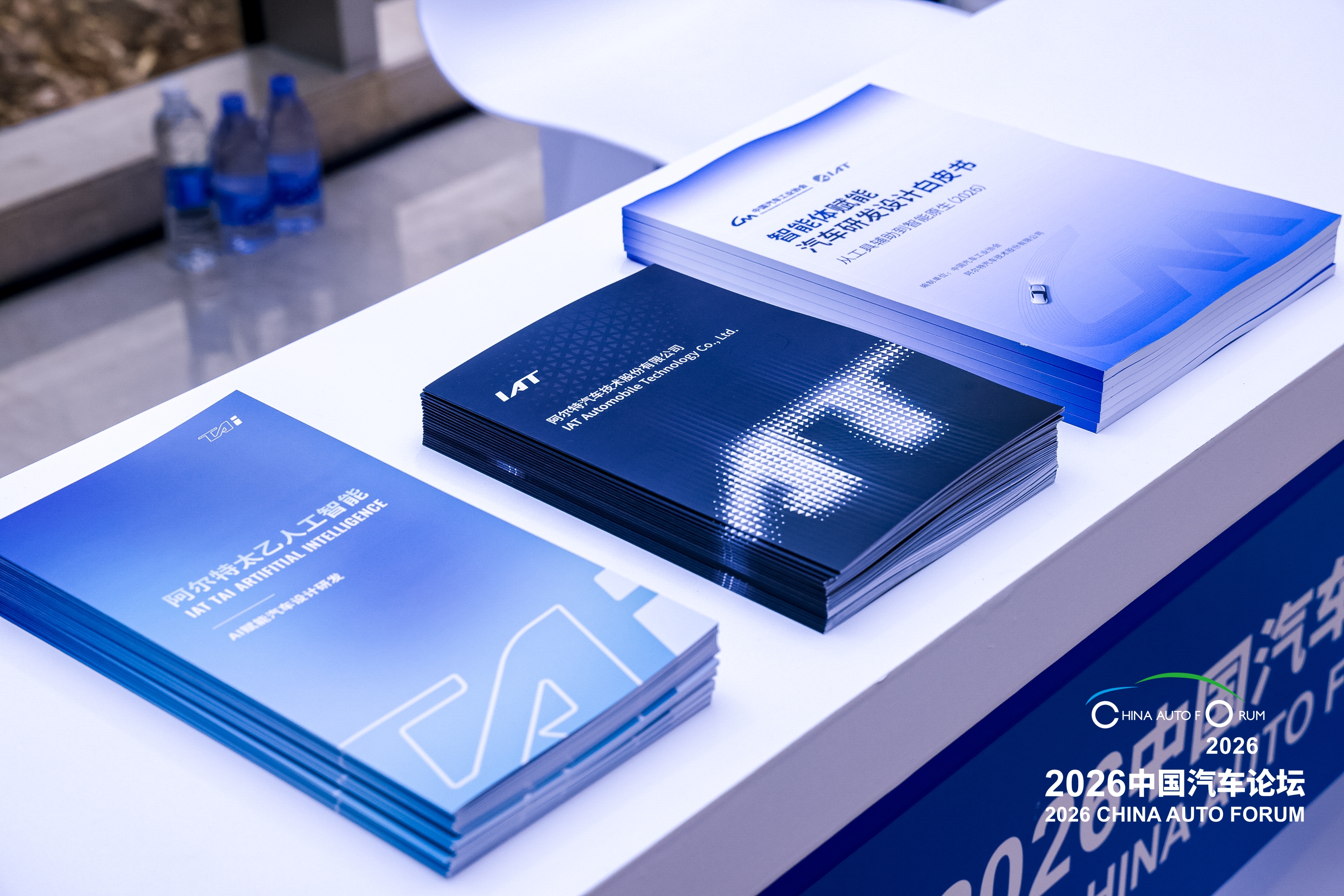
Founded in 2007, IAT, China’s first A-share listed independent automotive R&D firm, has successfully developed nearly 500 vehicle models for over 80 clients, with business covering the full vehicle R&D process. Now, IAT stands at the industry forefront in AI-empowered automotive R&D. At the end of 2025, it officially launched its new “AI + Digital Intelligent Creation” product portfolio, comprising three categories: intelligent large models, AI agents and creative design tools.
Among them, the “Yuanfang” large model acts as an “intelligent co-pilot” for engineers with its three core capabilities — drawing analysis, scheme generation and intelligent review — cutting design iteration cycles from weeks down to hours; “Yufeng” aerodynamic AI enables rapid prediction of aerodynamic performance; and the “TAI” styling AI platform supports creative generation and fast dimensional upgrading. These solutions, having been embedded in real R&D workflows, provide front-line practical support for the white paper.
Grounded in new quality productive forces and the national “AI Plus” strategy, the white paper systematically addresses three core issues.
First, how AI agents reshape R&D paradigms. The white paper clearly defines four core values of AI agents: end-to-end R&D efficiency improvement, knowledge capitalization, R&D paradigm reconstruction, and independent and controllable software. It is expected that AI agents will compress the vehicle R&D cycle from 36–48 months to 18–24 months, freeing engineers from repetitive work to focus on innovative design.
Second, how AI agents deliver tangible results on the ground. The white paper proposes a four-in-one technology foundation and a four-layer technical framework of “large models + industrial software + cloud-native architecture + AI agents”.
Centering on six application scenarios — knowledge engineering and semantics, multimodal perception and generation, scientific computing and physical simulation, 3D geometry and spatial topology, R&D collaboration and process automation, and automated reuse of engineering skills — it forms an AI agent application matrix covering the entire workflow of styling, design, simulation and verification. It also outlines a three-phase roadmap: Capability Building Phase (2025–2026), Scenario Scaling Phase (2027), and Platform Ecosystem Phase (2028–2029).
Third, how AI agents underpin high-quality industrial development. The white paper provides all-dimensional safeguard solutions covering organization, talent, data and security. It advocates engineering trustworthiness, data governance, open collaboration and independent standards. And it promotes the development of homegrown tool chains and standard systems.
The white paper sends a clear signal: automotive R&D is transitioning from “engineers operating tools” to “multi-agent collaborative AI-native driving”. Beyond algorithms and data, the competitive moat of future automakers also lies in the comprehensive strength of engineering expertise, physical mechanisms, industrial software connectivity, data governance, verification evidence chains and organizational synergy.
IAT, as a co-compiling party, was deeply involved in the entire process of the white paper, from framework design and core chapter writing to engineering verification. The release of the white paper also marks IAT’s strategic upgrade in AI-empowered automotive R&D — moving from isolated technological breakthroughs to the definition of industry standards.
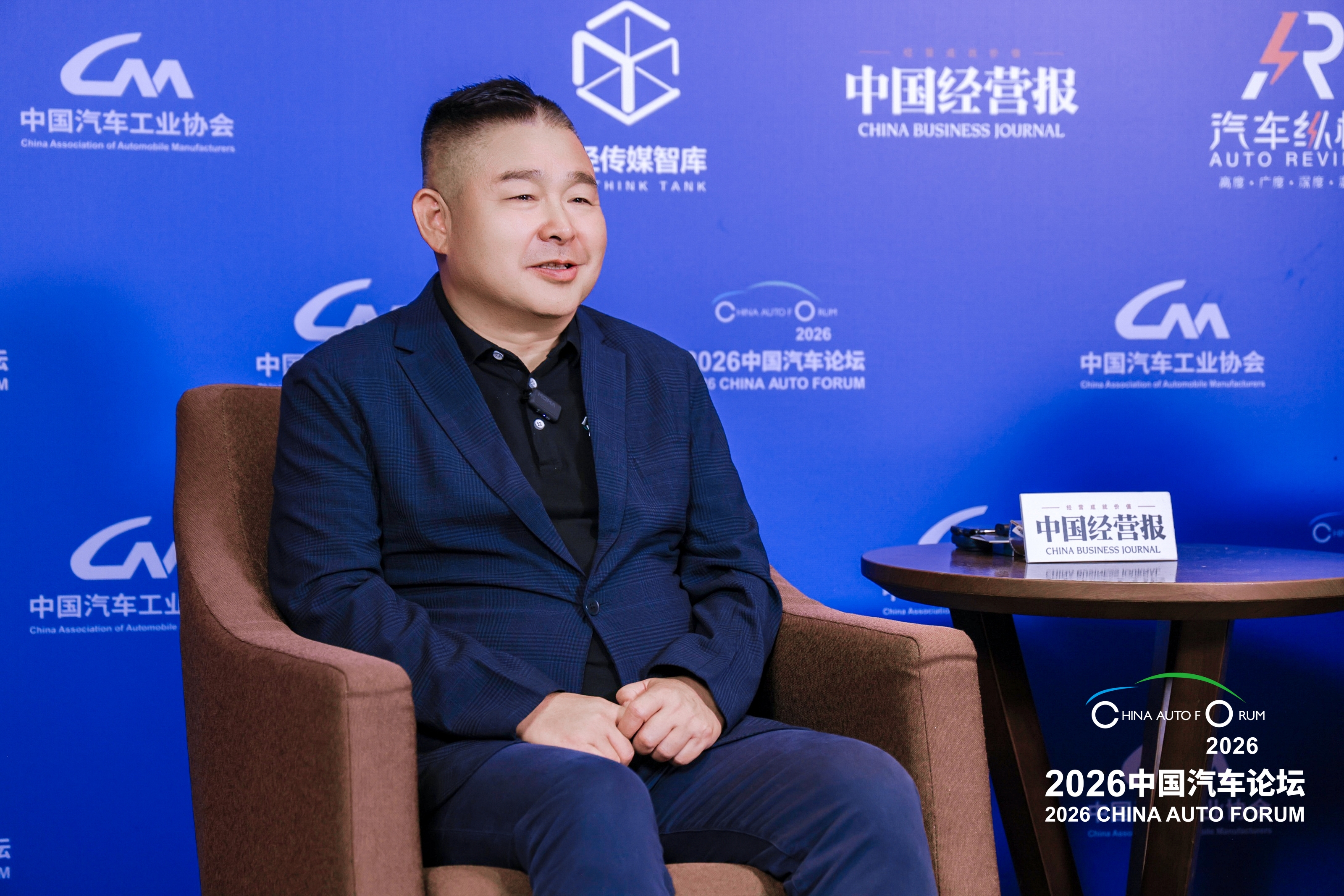
Photo: Chairman of IAT Automobile Technology Co., Ltd. speaks to media
The year 2026 marks the start of the 15th Five-Year Plan and a critical window for the new intelligent economy. IAT stated that it will take the white paper release as an opportunity to further advance its “AI + Digital Intelligent Creation” product system, deepening the integration of AI agents with automotive R&D. The firm will support China’s automotive industry in building globally leading R&D competitiveness, and, together with industry peers, usher in a new era where automotive R&D evolves from tool assistance to AI-native development.
Click to read the full white paper:/en/kindeditor/attached/file/20260813/20260813064039_56329.pdf
News
Copyright © 2021 IAT Automobile Technology Co., Ltd. 京公网安备11011502038290号 京ICP备05037845号