


Showcasing China’s Speed: IAT Attends 2026 China Auto Forum
Source: Author: Date:2026-08-13 Read:331
The 2026 China Auto Forum was held in Jiading District, Shanghai from July 21 to 23, 2026, under the theme of “New Start, New Opportunities, New Journey – Jointly Drawing a New Blueprint for High-Quality Development of the Automotive Industry”. Hosted by the China Association of Automobile Manufacturers (CAAM), this year’s forum comprises more than 16 sessions, including one closed-door summit, one plenary forum, one technology leaders summit and 13 thematic forums.
On the morning of July 23, Thematic Forum 9, titled “The Rise of Indigenous Design – Building a Distinctive Chinese Automotive Aesthetics and Cultural System”, was held as scheduled. Liu Haitao, Vice President of IAT Automobile Technology Co., Ltd., attended the forum and joined a roundtable discussion, holding in-depth exchanges with industry peers on topics including the structural transformation of Chinese automotive creativity and AI empowerment.

China’s automotive industry is now at a historic turning point, shifting from “manufacturing going global” to “creative awakening”, and is undergoing four major structural shifts: a transfer of discourse power from trend-following to standard-setting, methodological maturation from fragmented elements to systematic framework building, logic reconstruction from fuel-powered mechanical engineering to intelligent electric scenarios, and strategic upgrading from domestic market orientation to global aesthetic alignment.
However, homogenization challenges and the lack of a mature discourse system remain prominent obstacles.Against this backdrop, IAT has taken the lead in deeply integrating AI technology into automotive styling workflows. During the roundtable, Liu Haitao shared IAT’s practical experience: amid fierce industry competition and shortening R&D cycles, intelligent auxiliary tools can significantly boost efficiency. The traditional styling design process, which used to take weeks, can now be compressed to days or even minutes.
IAT’s “TAI” creative design platform supports concept generation and rapid implementation, while the “Yufeng” aerodynamic AI enables fast prediction of aerodynamic performance. Both products have been embedded in real R&D workflows, providing strong support for leapfrog improvements in automotive design efficiency.
Regarding the impact of generative technology on the industry, Liu Haitao holds a clear and rational stance. He acknowledged that industrial transformation is inevitable, and practitioners must embrace new technologies, yet new technologies are always a double-edged sword — tools may be constrained by existing design datasets rather than truly facilitating original creation.
Liu noted that in the new era, the core value of designers is shifting from “hand-drawn creativity” to “creative screening, critical judgment and concept deepening”. True competitiveness lies not in the volume of generated concepts, but in designers’ ability to master these tools and strike a balance between efficiency and originality.
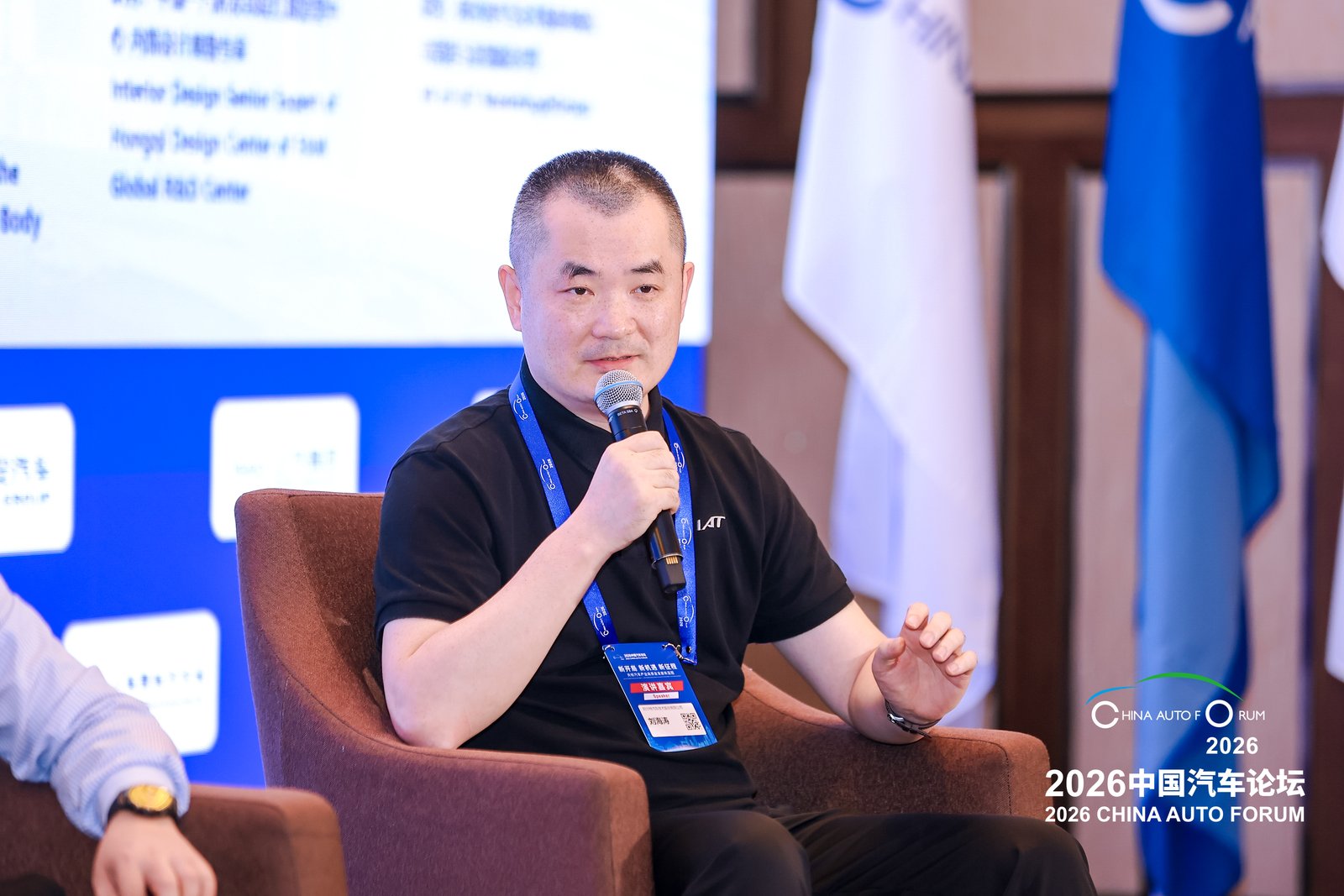
Photo: Liu Haitao, Vice Dean of IAT Styling Research Institute
These front-line practical insights align closely with the white paper unveiled at the forum. Grounded in new quality productive forces and the national “AI Plus” strategy, the white paper systematically addresses three core questions: how AI agents reshape R&D paradigms, how they deliver tangible results on the ground, and how they underpin high-quality industrial development.
It clearly puts forward a four-in-one technology foundation and a four-layer technical framework of “large models + industrial software + cloud-native architecture + AI agents”. Centering on six scenarios — knowledge engineering, multimodal perception, scientific computing, 3D geometry, R&D collaboration, and automated engineering skills — it forms an AI agent application matrix covering the full workflow of styling, design, simulation and verification.
The message conveyed by the white paper is fully consistent with Liu’s views: automotive R&D is shifting from “engineers operating tools” to “multi-agent collaborative AI-native driving”. Amid this transformation, China’s development speed relies on AI empowerment, but more importantly, it demands designers’ commitment to brand identity, user experience and the value of originality.
The year 2026 marks the opening year of the 15th Five-Year Plan and a critical window for the development of the new intelligent economy. Liu Haitao noted that taking the white paper release as an opportunity, IAT will continue to deepen the construction of its “AI + Digital Intelligent Creation” product system and advance the in-depth integration of AI agents with automotive R&D and design, accelerating China’s speed with AI.
It will help China’s automotive industry build world-leading R&D and design competitiveness, evolving from a “global sales champion” to a “global value benchmark”. Gradually cultivating a unique Chinese design language and cultural system that stands up to global scrutiny through open integration is the path that IAT and its industry peers will jointly pursue.
Click to read the full white paper:/en/kindeditor/attached/file/20260813/20260813065218_47014.pdf
News
Copyright © 2021 IAT Automobile Technology Co., Ltd. 京公网安备11011502038290号 京ICP备05037845号